Discover how different RTB ad formats work, where they perform best, and how publishers and advertisers can use them to create more effective programmatic campaigns.
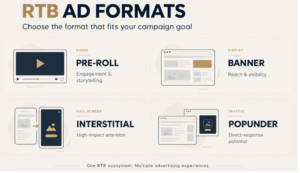
What Are RTB Ad Formats?
Real-Time Bidding (RTB) has transformed digital advertising by allowing advertisers to compete for individual ad impressions in milliseconds.
But RTB isn’t a single ad format.
From a short video before your favorite content to a banner embedded naturally within a webpage, each format creates a different user experience — and each can serve a different advertising objective.
At Adora Network, understanding these formats is key to building campaigns that balance visibility, engagement, performance, and user experience.
In this guide, we’ll explore four popular RTB formats:
- 🎬 Pre-roll video ads
- 🖥️ Banner ads
- ✨ Interstitial ads
- 🪟 Popunder ads
- Pre-Roll Ads
What are pre-rolls?
Pre-roll ads are video advertisements that play before the main video content begins.
Think of them as the digital equivalent of a commercial before a TV program — except RTB technology allows advertisers to bid for highly targeted impressions in real time.
A typical pre-roll can range from a few seconds to around 30 seconds, depending on the publisher and campaign.
Why use pre-roll advertising?
Video is one of the most engaging advertising formats because it combines motion, sound, storytelling, and visual branding.
Pre-rolls are particularly effective for:
Brand awareness
Put your brand in front of an audience before they engage with their desired content.
Product storytelling
Show how a product works instead of relying solely on static imagery.
High-impact campaigns
Video naturally attracts attention and can communicate more information within a short period.
Audience targeting
RTB allows advertisers to bid on impressions according to factors such as audience, device, geography, context, and other available targeting signals.
Best suited for:
🎯 Brand campaigns
🎬 Product launches
📱 Mobile campaigns
🚀 Awareness campaigns
🛍️ E-commerce
- Banner Ads
What are banner ads?
Banner advertising is one of the most established forms of digital advertising.
These are visual display ads integrated into websites and applications, typically appearing within content, alongside content, or in dedicated advertising placements.
Common banner formats include horizontal, vertical, square, and responsive display units.
Why use banners?
Banner ads offer advertisers a simple and scalable way to maintain visibility across a large number of digital environments.
Their key advantages include:
Broad reach
Display inventory is available across an enormous variety of websites and digital properties.
Visual branding
Colors, imagery, typography, logos, and calls-to-action can communicate a brand message instantly.
Scalability
Programmatic buying makes it possible to purchase impressions across multiple publishers and audiences efficiently.
Performance optimization
Campaigns can be optimized according to metrics such as impressions, clicks, conversions, and other campaign KPIs.
Best suited for:
📣 Brand awareness
🛒 Performance campaigns
🔄 Retargeting
🎯 Audience campaigns
🌐 Large-scale reach
- Interstitial Ads
What are interstitials?
Interstitial ads are full-screen advertisements that appear between two pieces of content or during a natural transition within a digital experience.
For example, an interstitial might appear when a user moves from one article to another, between levels of a mobile game, or during a transition within an app.
Because the format occupies most or all of the available screen, it creates a highly visible advertising moment.
Why use interstitial advertising?
High visibility
The large format gives the creative significantly more screen real estate.
Strong visual impact
Advertisers can combine imagery, messaging, branding, and calls-to-action in one immersive placement.
Mobile-friendly opportunities
Interstitials can be particularly effective in mobile environments when implemented thoughtfully.
Focused attention
Because the ad occupies the user’s screen, the message can be difficult to overlook.
The key is timing.
The most effective interstitial experiences are presented at natural breaks, rather than interrupting users in the middle of an important action.
Good advertising isn’t simply about being seen.
It’s about being seen at the right moment.
Best suited for:
📱 Mobile advertising
🎮 Gaming
🛍️ Product campaigns
✨ High-impact creative
🚀 Brand launches
- Popunder Ads
What are popunders?
A popunder is an advertising format where an ad or landing page opens in a new browser window or tab behind the user’s current browsing session.
Unlike a traditional pop-up, the advertising experience doesn’t immediately cover the content the user is viewing.
The user can continue with their current activity while the advertising destination remains available in the background.
Why use popunders?
Low interruption
The current browsing experience isn’t immediately replaced by an advertising message.
Additional reach
Popunder inventory can complement display, video, and other programmatic formats.
Direct-response potential
The format can work well when the objective is driving users toward a specific landing page or offer.
Broad campaign applications
Popunders can be used for campaigns where direct traffic generation is an important KPI.
Best suited for:
🚀 Traffic acquisition
🎯 Direct response
🌐 Landing-page campaigns
📈 Performance marketing
🔄 Complementary reach
One RTB Ecosystem. Multiple Advertising Experiences.
Different formats solve different problems.
A brand looking to tell a story may benefit from video.
A company looking for consistent visibility may choose banners.
A campaign requiring high-impact screen presence may use interstitials.
And a performance-focused advertiser may consider popunders as part of a broader traffic strategy.
The real opportunity comes from understanding how these formats can work together.
A simplified campaign journey:
REACH
Banner
↓
ENGAGE
Pre-roll
↓
IMPACT
Interstitial
↓
CONVERT
Popunder / Landing Page
The right combination depends on the audience, inventory, campaign objective, creative, and user experience.
Why RTB Makes These Formats More Powerful
The real-time bidding ecosystem adds another layer to traditional advertising formats.
Instead of simply purchasing a fixed placement, programmatic technology can allow advertisers to evaluate individual impressions and compete for inventory in real time.
That means campaigns can become more:
🎯 Targeted
Reach relevant audiences using available targeting signals.
⚡ Efficient
Automate buying decisions at enormous scale.
📊 Measurable
Monitor campaign performance and optimize based on results.
🌍 Scalable
Access inventory across multiple digital environments.
🔄 Flexible
Adjust campaign strategies based on performance and objectives.
Choosing the Right Format
| Format | Main Strength | Ideal For |
| 🎬 Pre-roll | Storytelling & engagement | Video / brand campaigns |
| 🖥️ Banner | Reach & visibility | Awareness / performance |
| ✨ Interstitial | High-impact visibility | Mobile / gaming / launches |
| 🪟 Popunder | Traffic generation | Direct response / acquisition |
There isn’t one universally “best” RTB format.
The best format is the one that matches the campaign objective and user context.
The Future of Digital Advertising Is About Context
As programmatic advertising continues to evolve, successful campaigns will increasingly depend on more than simply buying impressions.
They will depend on delivering the right message, in the right format, to the right audience, at the right moment.
Whether it’s a six-second video, a beautifully designed banner, an immersive interstitial, or a performance-oriented popunder, each format has a role to play in the modern advertising ecosystem.
The opportunity is not choosing one format.
It’s knowing when to use each one.